
For decades, the clinical understanding of Primary Ciliary Dyskinesia (PCD) was relatively straightforward: PCD causes defective mucociliary clearance because the airway cilia do not beat normally, but the body's cough reflex remains intact and provides an important backup mechanism for moving mucus out of the lungs.
Because cough can help compensate for impaired mucociliary transport, airway-clearance therapies for PCD have traditionally focused on mobilizing mucus so that the person can cough it out. Current clinical guidance continues to emphasize cough as an important component of airway clearance.
But there is a more complicated question emerging:
Is cough clearance always as effective in PCD as we have historically assumed?
The answer may not be as simple as "yes."
Research into airway biology, ciliary signaling, chronic inflammation, bronchiectasis, and the nervous system is beginning to highlight the possibility that the relationship between cilia, mucus, airway sensory signaling, and cough is more complex than previously understood.
The cilia and the cough reflex are different systems—but they interact
The cough reflex itself is not generated by the airway cilia. It involves sensory receptors in the respiratory tract, nerves including the vagus nerve, and processing within the brainstem.
However, the airway environment in which those sensory receptors operate can change dramatically in PCD.
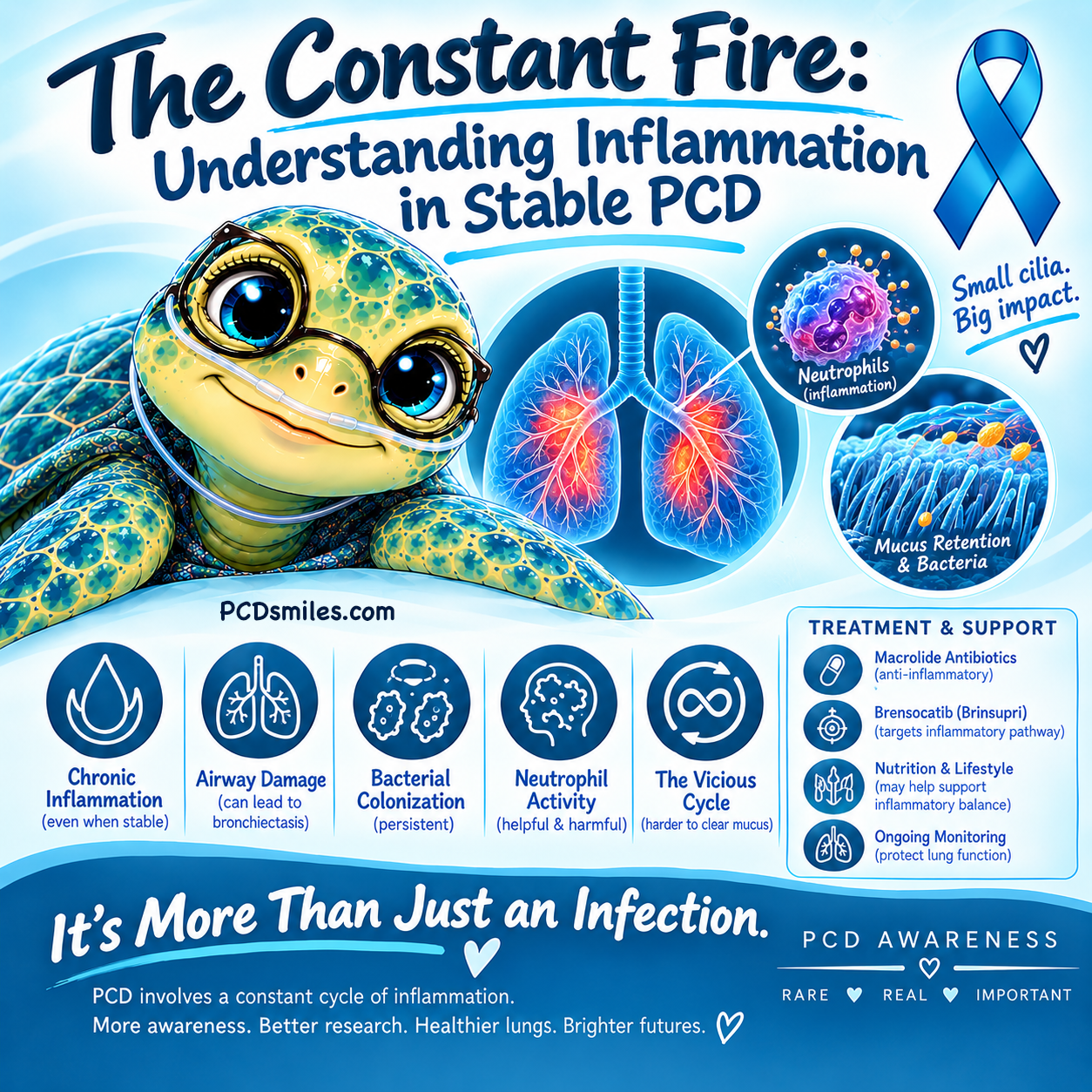
When cilia cannot effectively transport mucus, secretions can remain in the airways for prolonged periods. Chronic mucus retention is accompanied by recurrent infection, inflammation, and epithelial injury. PCD predominantly affects the lungs, sinuses, and ears, and chronic wet cough and recurrent respiratory infections are characteristic features of the disease.
This raises an important question about whether persistent mucus, inflammation, and airway injury can alter the way sensory pathways respond to airway stimulation.
In other airway diseases, researchers have demonstrated that chronic inflammation and epithelial injury can alter cough sensitivity. Interestingly, studies in bronchiectasis have actually found increased, rather than decreased, cough sensitivity in some patients.
Therefore, the idea of "cough receptor exhaustion" or desensitization should currently be viewed as a potential mechanism requiring further research, rather than an established feature of PCD.
The important point is that having the ability to cough does not necessarily mean that coughing will always provide adequate mucus clearance.
PCD is genetically diverse
PCD is not one uniform disease.
It is caused by pathogenic variants in numerous genes that affect the structure and function of motile cilia. More than 50 genes have been associated with PCD.
Different genetic defects can produce different ciliary structures, different patterns of ciliary movement, and different clinical manifestations.
Cilia are also found outside the respiratory tract. They are involved in multiple biological processes throughout the body, including sensory and developmental functions.
This genetic and biological diversity raises the possibility that airway sensory signaling and cough responses may not be identical in every person with PCD.
Some proposed mechanisms involve interactions between cilia, epithelial cells, extracellular signaling molecules, sensory pathways, and the nervous system. These areas are still being investigated, and more research is needed before specific genetic variants can be definitively linked to clinically meaningful differences in cough reflex function.
That distinction matters.
PCD should not be assumed to produce the same airway-clearance experience in every person who has it.
A cough can be present without being an effective clearance mechanism
A cough is a powerful mechanical event.
To clear mucus effectively, airflow must generate enough force to move secretions away from the airway walls and toward the larger airways, where they can be expelled.
This becomes particularly important as PCD-associated lung disease progresses.
Repeated infections and chronic inflammation can cause structural damage to the airways. Over time, some people with PCD develop bronchiectasis—permanent widening and remodeling of the bronchial tubes. Bronchiectasis is a recognized complication of PCD and can further interfere with effective secretion clearance.
The result can become a vicious cycle:
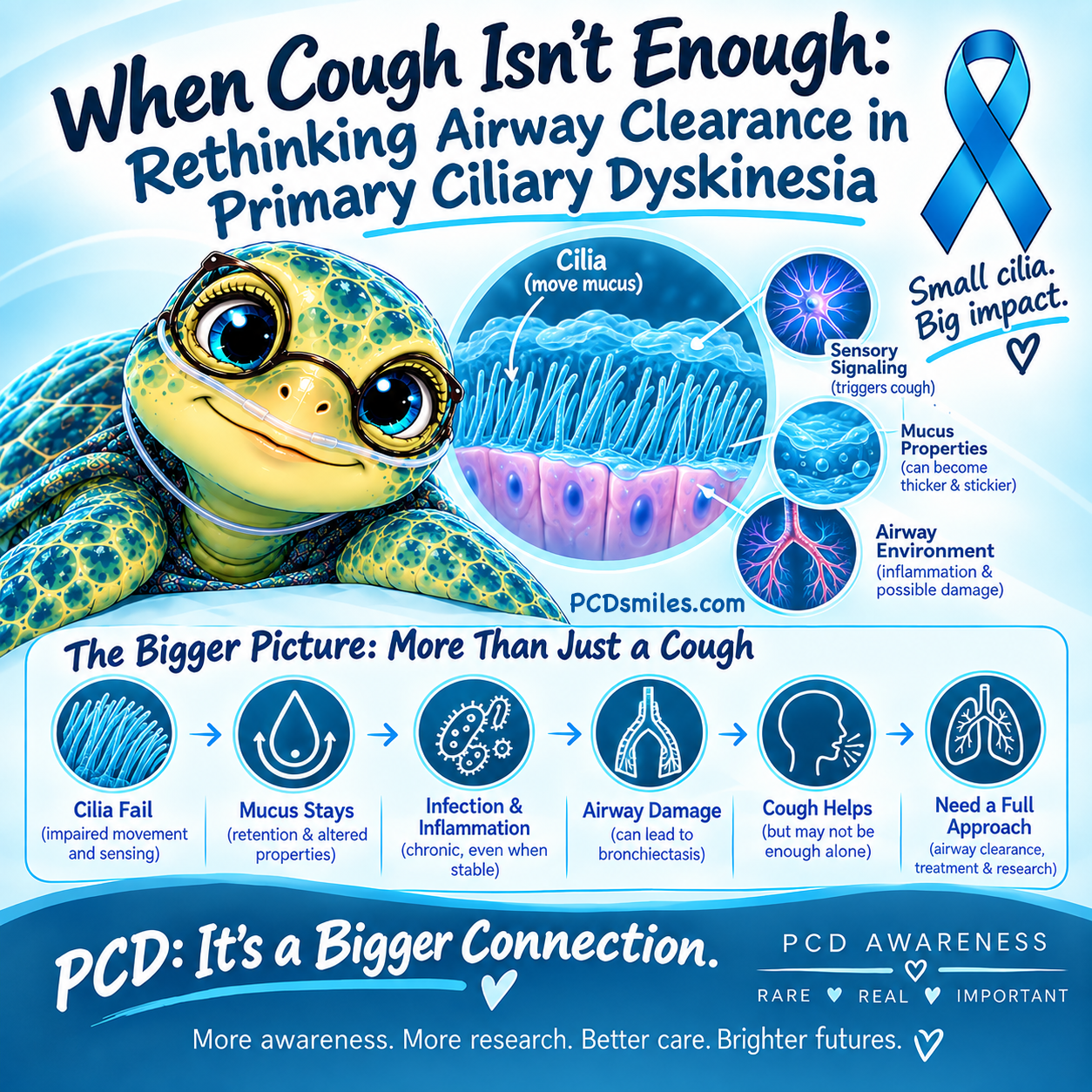
Impaired ciliary movement → mucus retention → infection and inflammation → airway damage → bronchiectasis → impaired mucus clearance.
Even when a person has a strong urge to cough and can produce a forceful cough, altered airway structure and mucus properties may make clearing secretions more difficult.
This is one reason why "the patient can cough" and "the patient can effectively clear their lungs" are not necessarily equivalent statements.
Mucus itself changes the equation
Cough does not operate in isolation.
The physical properties of airway mucus matter enormously.
When mucus becomes concentrated and sticky, it adheres more strongly to airway surfaces and becomes harder to transport. In bronchiectasis and other chronic airway diseases, mucus dehydration can compress the periciliary layer and interfere with mucus transport.
For someone with PCD, defective ciliary movement already compromises the normal mucus-transport system.
If the mucus becomes increasingly concentrated, the mechanical challenge becomes even greater.
This creates another important concept:
A functioning cough does not automatically overcome severely abnormal mucus properties.
The effectiveness of cough depends on the interaction between airflow, airway structure, mucus viscosity and adhesivity, airway diameter, and the location of the secretions.
This is why airway clearance remains so important
The evolving understanding of cough does not mean that coughing is unimportant in PCD.
Quite the opposite.
Cough remains an essential part of the body's defense against retained airway secretions, which is why treatment strategies are designed to mobilize mucus and make it easier to cough out. The National Heart, Lung, and Blood Institute describes coughing as an important mechanism for clearing mucus in PCD and recommends approaches such as chest physical therapy, breathing techniques, exercise, and airway-clearance devices.
PCD Foundation recommendations likewise emphasize daily airway clearance as a cornerstone of long-term treatment.
Airway-clearance approaches may include:
- Chest physiotherapy/percussion
- High-frequency chest wall oscillation vests
- Oscillation and lung expansion (Volara System by Baxter)
- Positive expiratory pressure (PEP) devices
- Breathing and huff-cough techniques
- Exercise
- Nebulized saline or hypertonic saline when prescribed
- Other individualized airway-clearance strategies
Current expert guidance emphasizes that airway clearance should be individualized rather than assuming one technique works equally well for everyone.
The bigger question: What else happens when cilia fail?
This is where PCD research becomes particularly interesting.
The traditional picture is:
Cilia don't move → mucus isn't transported → cough clears the mucus.
But airway biology may be considerably more interconnected:
Cilia → airway surface environment → mucus properties → epithelial signaling → sensory pathways → cough → mucus clearance.
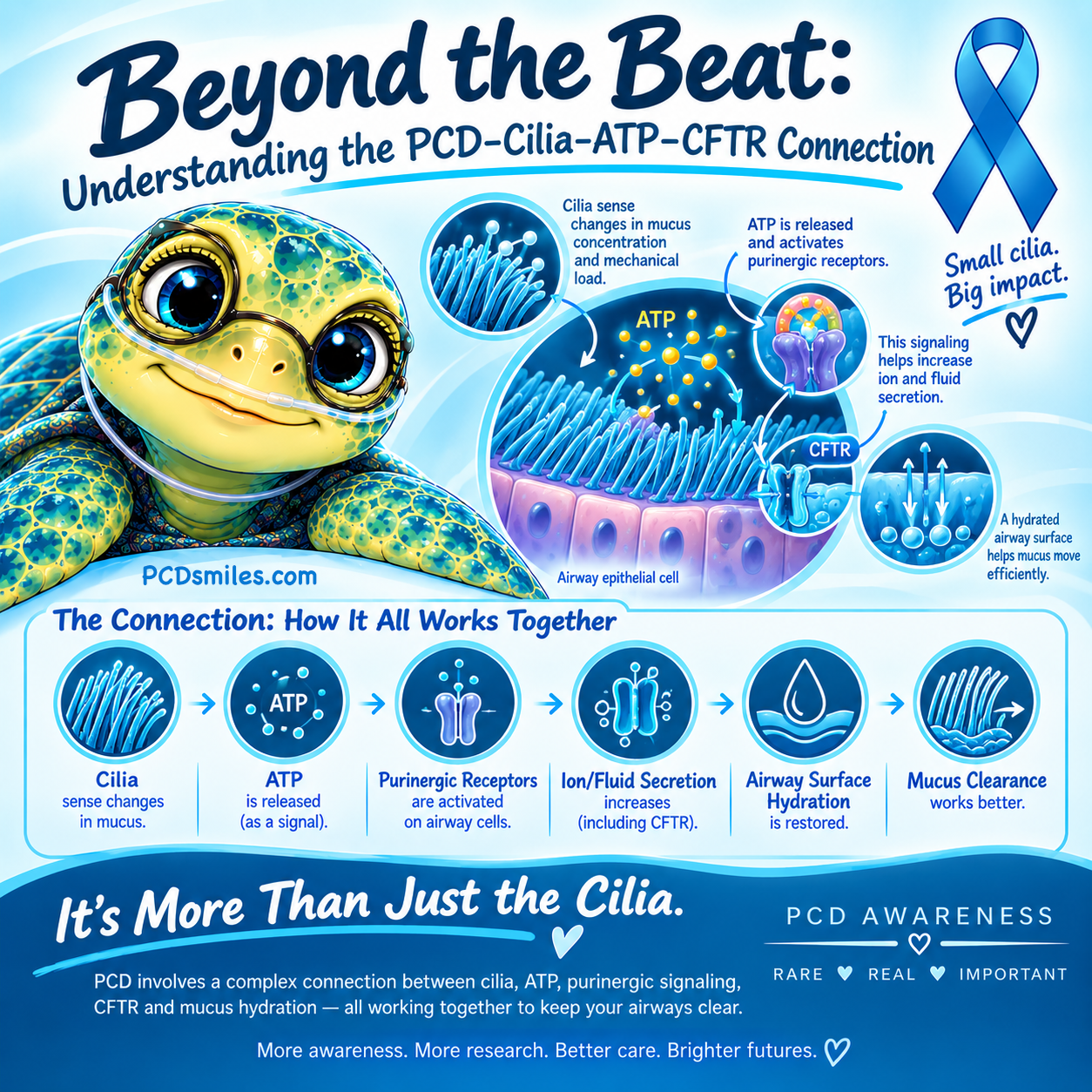
Cilia are not simply microscopic "brooms." They exist within a complex airway environment involving epithelial cells, mucus, ion and water transport, extracellular signaling molecules, sensory receptors, immune responses, and neural pathways.
Understanding these interactions could help researchers explain why two people with PCD can have very different experiences with mucus, coughing, infections, and lung disease.
It may also identify new therapeutic targets.
What we know—and what we still need to learn
There is strong evidence that PCD causes defective mucociliary clearance and that airway clearance is an essential part of managing the disease.
There is also strong evidence that chronic infection and inflammation can contribute to progressive airway damage and bronchiectasis.
What remains less certain is how much variation exists in cough sensory signaling and cough effectiveness among people with PCD, and whether particular genetic or biological subtypes are associated with altered cough responses.
That is an important research question—not a settled clinical fact.
The takeaway
PCD has traditionally been described as a disease in which the cilia fail, but cough takes over.
A more complete view may be:
The cilia fail, the airway environment changes, mucus becomes difficult to move, the airways can become damaged, and cough becomes one part of a much larger—and highly individual—airway-clearance system.
Understanding that system could ultimately lead to better ways of predicting who is at risk for progressive lung disease, improving airway-clearance strategies, and developing treatments that address more than the movement of mucus alone.
PCD is a disease of cilia—but the consequences of dysfunctional cilia extend far beyond the cilia themselves.
Be sure to join us tomorrow for another conversation about primary ciliary dyskinesia.
Join our Facebook group Turtle Talk Café today.
We have several ways that you can donate to PCD Smiles;
- Visit Smile E. Turtle's Amazon Wishlist
- For more information on how you can donate, please visit our "Donation" page to check out our "Do & Don't policies.
- Or sponsor a PCD Smiles cheer package today!
- To shop for your “Official” turtle care ribbon gear today, visit PCD Style
Thank you for your consideration!
This article discusses emerging research and hypotheses. It should not be interpreted as establishing that cough-reflex impairment or desensitization occurs universally in PCD. Individual airway-clearance needs should be determined with a clinician familiar with PCD.
Medical Disclaimer
This article is intended for general educational and informational purposes only and is not a substitute for professional medical advice, diagnosis, or treatment. Infection risks and appropriate prevention strategies can vary considerably between people with PCD based on their lung health, respiratory cultures, treatments, age, and other medical conditions.
Cleaning and disinfection recommendations for respiratory equipment can also vary by device and manufacturer. Always follow the instructions provided by your healthcare team and equipment manufacturer.
Do not start, stop, or change medications, airway-clearance treatments, infection-control practices, or other aspects of your medical care based solely on this article. If you have PCD and are concerned about an infection, worsening respiratory symptoms, or possible exposure to a pathogen, contact your PCD or respiratory healthcare team for individualized guidance.
If you are experiencing severe or rapidly worsening breathing difficulties or another medical emergency, seek urgent medical attention.